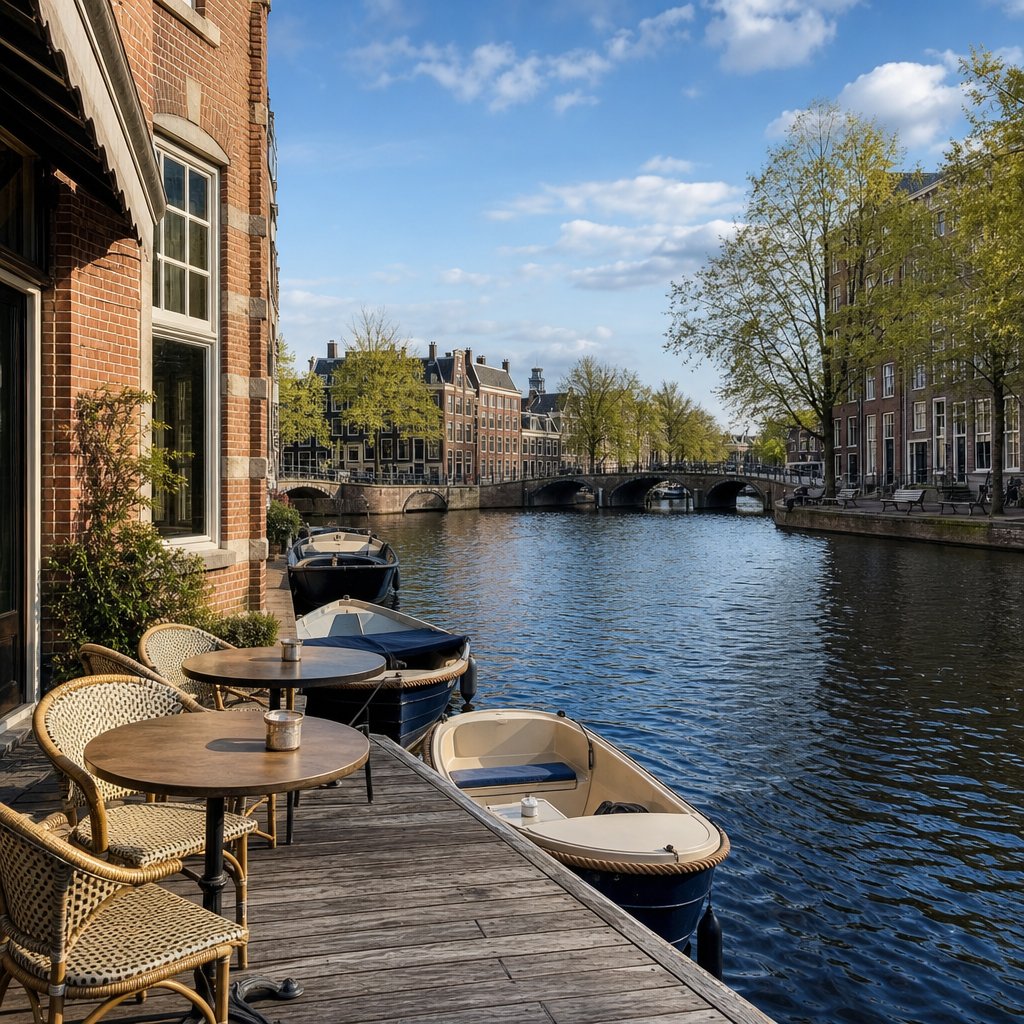
On the water
De Ceuvel: the Former Shipyard Turned Waterside Cafe in Amsterdam-Noord
On a bend of the water in Amsterdam-Noord, a polluted old shipyard has become one of the city's most unusual waterside cafes, green, off-grid and built almost entirely from salvage.
De Ceuvel sits on the Johan van Hasseltkanaal in the Buiksloterham district of Amsterdam-Noord, on a plot that was once a shipyard and, for years after, a stretch of contaminated industrial land. Rather than dig it all out, the people who rebuilt it left the soil in place and planted it with species that slowly draw the pollution up and out, so the whole site sits on a working experiment in cleaning the ground it stands on. Old houseboats were hauled out of the water, set on the bank and turned into workspaces for small studios and start-ups, and a cafe was built at the water's edge to go with them.
The result is a place that feels quite unlike the canal-house centre a short ferry ride away. Timber walkways thread between the beached houseboats, the buildings are patched together from reclaimed material, and much of the site runs off-grid, generating and cleaning a good deal of what it uses on the spot. For a visitor, the draw is simple: a relaxed cafe with a terrace over the water, and a setting that rewards a wander before or after a drink.
Where De Ceuvel is and how it sits on the water
The site is in Buiksloterham, a former industrial quarter of Amsterdam-Noord that has been filling with houseboats, self-build homes and creative workspaces for years. De Ceuvel lies just back from the IJ on one of the northern canals, close enough to the water that the terrace and the beached boats define the whole feel of the place. It reads as a working yard as much as a cafe, which is exactly the point.
Because it sits across the IJ from the centre, De Ceuvel belongs to the same north-bank cluster as Pllek and Roest, and the three are easy to combine on one trip. All of them are covered in the roundup of waterside cafes and bars.
Getting there, by ferry or by boat
The simplest way over is the free GVB ferry from behind Centraal Station to the Buiksloterweg landing, then a short walk or ride into Buiksloterham; the guide to getting around Amsterdam by boat sets out the ferry routes across the IJ. Arriving in your own boat is possible but takes more planning: the IJ is open water with working traffic and its own rules, not a quiet canal, so it is not the place for a first outing at the tiller. If you do come by water, read the boating rules and etiquette first, and do not assume there will be a free mooring waiting outside.
What to expect at the cafe
The cafe serves a plant-based menu and keeps a long terrace out over the water, which is where most people end up on a fine day. The mood is unhurried, closer to a canal-side hangout than a restaurant, and it draws a mix of the studios working on site, locals from the surrounding new-build blocks and visitors who have made the short crossing. Alongside the food and drink, the site runs a programme of markets, talks and planting days tied to its green, circular ethos, so there is often something on beyond the cafe itself.
Hours and the seasonal terrace setup change through the year, and the site is busiest on warm weekends, so it is worth checking ahead if you are making a special trip rather than dropping in while you are already in Amsterdam-Noord.
De Ceuvel and the canal events
De Ceuvel is not on the route of the big canal events, and that is part of its appeal during the busiest weekends. When the central water is jammed for the Canal Parade or through the ten days of the Grachtenfestival, the north bank stays calmer while remaining a short ferry hop from the action. It makes an easy pairing: the event on the water in the centre, then a quieter drink across the IJ. The events map and calendar shows what is on and when.
The neighbourhood around it
De Ceuvel is one corner of Buiksloterham, a former industrial quarter of Amsterdam-Noord that has spent the past decade turning into one of the city's most experimental residential districts. The blocks around it mix self-build homes, floating houses moored along the banks and a scatter of studios and workshops, much of it put up with the same low-impact, do-it-yourself spirit as the site itself. It rewards a wander: the water is never far, the architecture is unlike anything in the old centre, and the whole quarter still feels half-finished in a way that is part of its appeal. Come for the cafe, but leave time to walk the surrounding banks, where houseboats and new-build homes sit side by side along the water.
What is De Ceuvel?
A former shipyard in Amsterdam-Noord rebuilt as a green, largely off-grid workplace for small studios, with a plant-based cafe and a terrace over the water. Old houseboats set on the bank serve as the workspaces, and the site cleans its own contaminated soil with planting.
How do I get to De Ceuvel?
Take the free GVB ferry from behind Centraal Station to the Buiksloterweg landing, then walk or ride a short way into the Buiksloterham district. It can be reached by small boat, but the IJ is open working water and needs care.
Is the cafe plant-based?
Yes. The cafe serves a plant-based menu, in keeping with the site's circular, low-impact ethos.
Is De Ceuvel a good spot during the canal events?
It is a good quieter alternative. It sits off the event routes across the IJ, close enough for a short ferry hop but away from the crowds on the central canals.