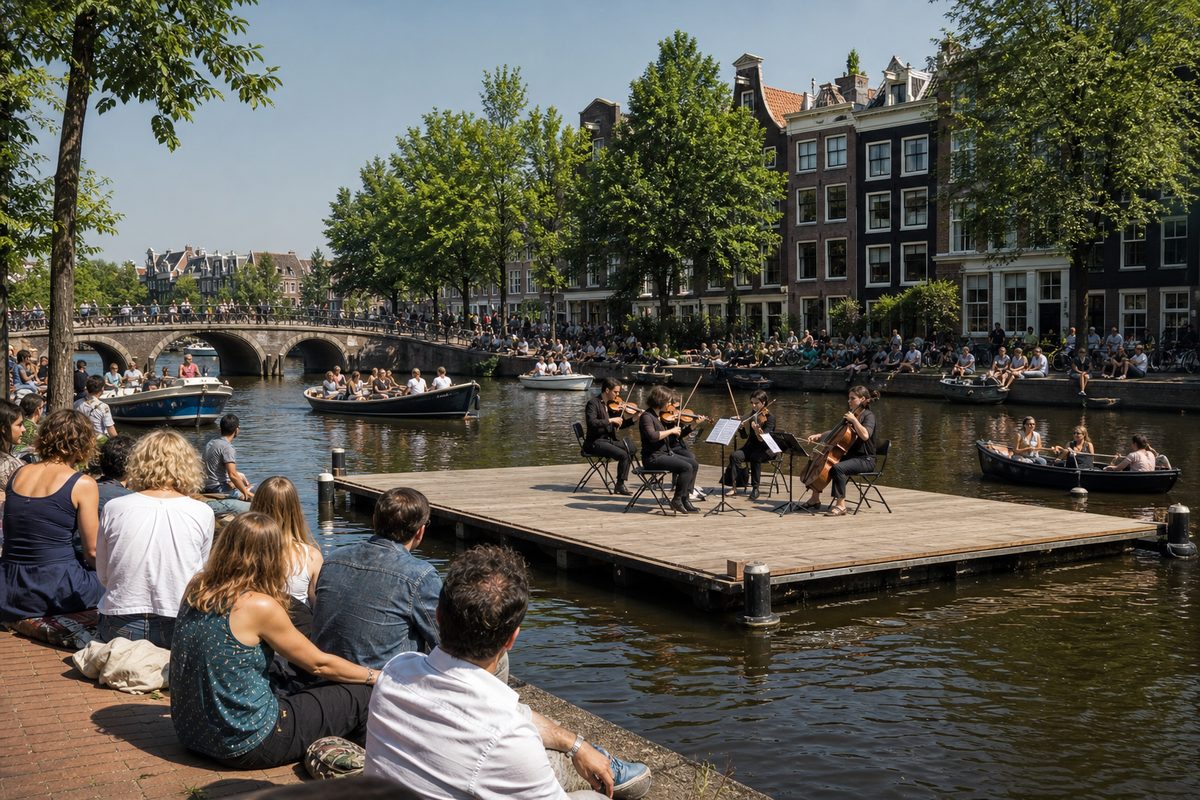
Ten days of music on the canals
The Grachtenfestival Amsterdam: Ten Days of Classical Music Across the Canals
For ten days in August, concerts pop up on pontoons, in courtyards and canal houses all over the city. Here is what the Grachtenfestival Amsterdam is and how to navigate it.
The Grachtenfestival Amsterdam is one of the largest classical music festivals in the Netherlands, staged not in a single hall but across the canals and hidden corners of the city. Over roughly ten days in August it puts on dozens of concerts, many of them built around young musicians from around the world. As an amsterdam canal music festival it turns the whole centre into a venue.
Run by the Stichting Grachtenfestival, the festival is known for pairing serious repertoire with unusual settings, so a concert might take place on a floating stage, in a monumental courtyard or inside a canal house. That mix of location and programme is what makes it accessible rather than stuffy.
Classical music across the Amsterdam canals
Concerts range from free open-air performances to ticketed events in special venues. The festival draws tens of thousands of visitors across its run, and because it spreads right across the centre of Amsterdam, you can often walk from one performance to the next along the canals. The classical programme is deliberately wide, from solo recitals to small ensembles, so no two days feel the same. Many concerts are short and early, which makes it realistic to catch two or three in an afternoon if you plan the walking route between them.
| Event | Grachtenfestival |
|---|---|
| What | Ten-day classical music festival across the city |
| Where | Canals, courtyards and canal houses throughout Amsterdam |
| When | Ten days in August |
| Organiser | Stichting Grachtenfestival |
| Highlight | The Prinsengrachtconcert |
The festival highlight on the canals
The undisputed centrepiece is the Prinsengrachtconcert, the free floating concert on the Prinsengracht that closes the programme and draws the biggest crowd of the whole amsterdam canal music festival. If you only catch one thing, make it that; if you have more time, the smaller daytime concerts are where the festival's character really shows.
Because the concerts are scattered across the canals, a little planning pays off. Pick a neighbourhood, line up two or three performances within walking distance, and leave room to stumble into an open-air set you did not plan for.
Planning your Grachtenfestival visit
Programmes and venues are published each summer. Popular ticketed concerts sell out, while the open-air performances are first-come, first-served, so a mix of the two makes for the most reliable day at the Grachtenfestival. Check dates each year: the festival moves within August rather than sitting on a fixed set of dates.
How the festival is organised
The Grachtenfestival is less a single venue than a map of small ones. Over its ten days it programmes dozens of concerts across the centre, on floating stages, in monumental courtyards, inside canal houses and in hidden gardens that are otherwise closed to the public. That spread is deliberate: the festival is built to send you walking from one performance to the next along the water, discovering corners of the city you would never otherwise see.
The programme mixes free open-air performances with ticketed concerts in special settings, and it leans hard on young musicians at the start of their careers, which keeps the line-up fresh from year to year. Tickets for the popular indoor concerts sell out early once the programme is published each summer, while the open-air performances are first-come, first-served. A sensible plan is to book one or two ticketed highlights, then fill the gaps with free concerts and the odd unplanned discovery. The whole thing builds toward its free floating finale, the Prinsengrachtconcert, which draws the largest crowd of the festival.
Part of the character of the Grachtenfestival is how informal it stays despite its scale. Many concerts are free, most are short, and the settings (a courtyard, a canal-house room, a floating stage) put you unusually close to the musicians. That intimacy, spread across ten days and dozens of small events, is what keeps regulars coming back year after year, and it makes the festival easy to dip into for an hour rather than committing to a whole evening.
Free concerts and ticketed events
The Grachtenfestival works on two levels at once. A backbone of free open-air concerts, on pontoons, in courtyards and on the water, means anyone can dip into the festival without a ticket or a plan, simply by being in the right neighbourhood at the right time. Alongside them runs a programme of ticketed concerts in special settings, canal houses, hidden gardens, churches and grand interiors not usually open to the public, where the setting is as much of a draw as the music. The ticketed events are where the festival puts its more ambitious programming and its more sought-after performers, and the popular ones sell out well ahead, so they reward booking early; the free concerts reward turning up and wandering.
Seeing the festival from the water
Because so much of the Grachtenfestival happens on and beside the canals, a boat changes how you experience it. Several of the open-air concerts are staged on pontoons or at the water's edge and can be watched from a moored boat, and drifting between venues along the canals is a pleasant way to string a few together. If you want to do this, the usual water rules apply, and the busier concert spots fill early; the guide to getting around Amsterdam by boat and the guide to renting a boat cover the practical side, while the boating rules and etiquette matter in the crowds a popular concert draws to the water.
Making the most of ten days
Ten days and dozens of concerts across the city can be daunting, so a little strategy helps. Rather than chasing individual names, pick a neighbourhood or a day and build a small itinerary around it, two or three concerts within walking or cycling distance, with time for a canal-side coffee in between. The published programme groups events by area and time, which makes this easy to plan. Mixing one ticketed concert in a special venue with a couple of free open-air performances tends to give the fullest sense of what the festival is: serious music in unlikely, beautiful places, threaded through the everyday life of the canals.
Where the concerts happen
Much of the festival's character comes from its venues. Alongside the pontoons on the canals, concerts take place in the grand rooms of private canal houses, in hidden courtyard gardens, in churches and in museum halls, many of them places the public rarely gets to see from the inside. The setting is chosen to suit the music, or the music to suit the setting, so a baroque programme might be played in a period interior and a contemporary piece in a raw industrial space across the IJ. For a visitor, this turns concert-going into a way of getting behind the facades of the canal ring and into corners of the city that are otherwise closed, which is a large part of why the festival has the following it does.
That spread of venues also shapes how the festival feels day to day. Because the concerts are scattered rather than gathered on one site, the whole city becomes the festival ground, and moving between performances, on foot, by bike or by boat, is part of the experience rather than dead time. It rewards curiosity: some of the most memorable concerts are in the least obvious places.
Who plays
The Grachtenfestival has built its reputation as a platform for young and emerging musicians as much as a showcase for established names. A significant part of the programme is given over to talent at the start of their careers, and the festival runs strands and prizes aimed specifically at them, so an afternoon concert in a canal house might introduce you to a performer years before they are widely known. The repertoire is correspondingly broad, from early and baroque music through the classical canon to contemporary and crossover work, which means the festival casts a wide net rather than catering to one taste. For an audience, the mix of unfamiliar performers and unusual settings is exactly the appeal: it is a festival built for discovery rather than for ticking off famous names.
The festival also keeps its barriers low. Many of the concerts featuring emerging musicians are free or modestly priced, so it stays genuinely open rather than becoming an event only for those who book the marquee names months ahead. That openness, serious music in unusual venues, new performers and a low bar to entry, is the balance the Grachtenfestival has struck for years, and it is why it draws both dedicated concert-goers and passers-by who simply follow the sound of a cello across a canal.
For a first-time visitor, the safest approach is to treat it as a festival to wander into rather than one to study in advance. Pick up the programme, choose a single ticketed concert in a setting that appeals, and let the free open-air performances fill in around it as you come across them. The scale can look daunting on paper, dozens of concerts over ten days, but on the ground it resolves into something simple: good music turning up in beautiful, unexpected places, all across the city, for anyone who cares to go and listen. And because it returns every August, it rewards coming back: regulars build a sense over the years of which venues suit which music, which neighbourhoods stay quietest and which strands of the programme are worth following, so the festival deepens with familiarity rather than wearing thin.
The Grachtenfestival and the summer's other concerts
The Grachtenfestival is the biggest of the classical events on the water, but it is not alone. Earlier in the summer the Spiegelconcert brings a floating stage to the Keizersgracht, a smaller, neighbourly cousin of the festival's open-air concerts, and the festival's own finale, the Prinsengrachtconcert, is the single most famous evening of the lot. Taken together they make a season of music on the water running from June into August. The events map and calendar shows how the concerts fall so you can plan around them.
How long does the Grachtenfestival last?
About ten days in August, with dozens of concerts across the city each year.
Are the concerts free?
Some are. The Grachtenfestival Amsterdam programme mixes free open-air performances with ticketed concerts in special venues.
What is the festival's biggest event?
The Prinsengrachtconcert, a free floating classical concert that closes the amsterdam canal music festival on the Prinsengracht.
How do I plan which concerts to see?
Group a few performances by neighbourhood so you can walk between them, and mix ticketed concerts with free open-air ones.