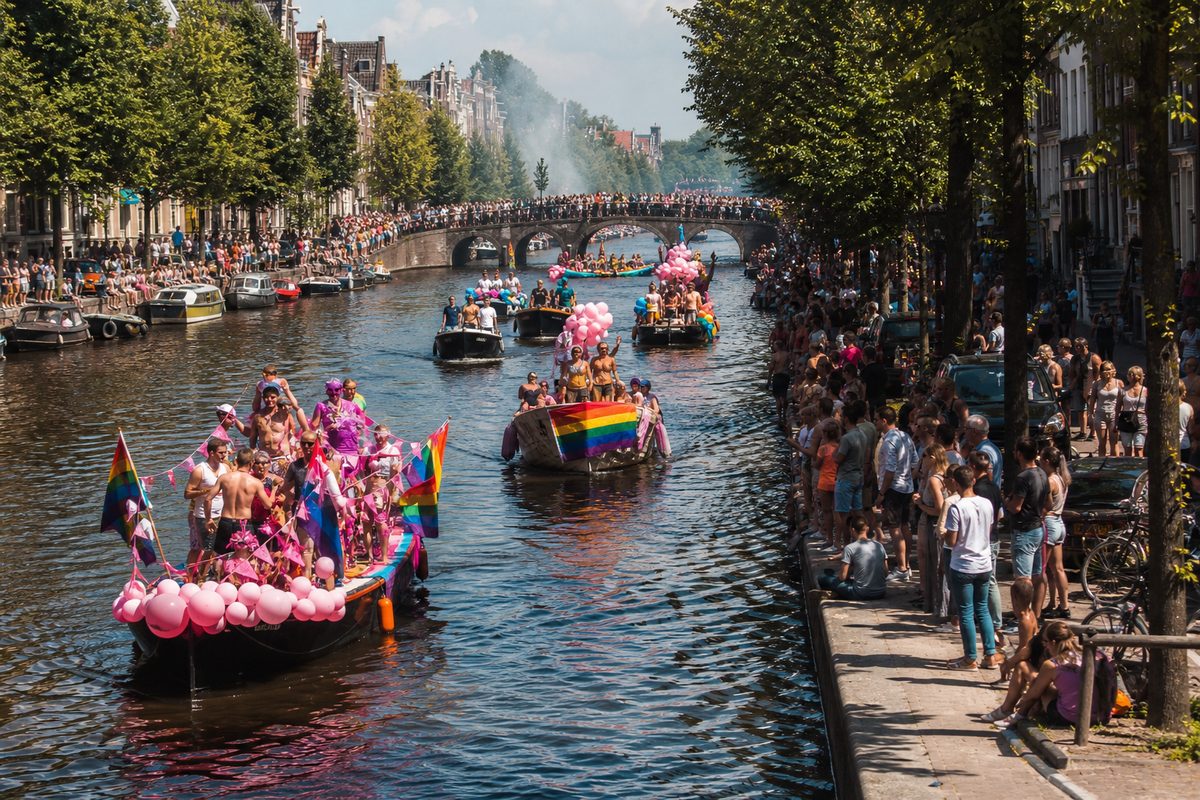
The highlight of Pride
The Amsterdam Canal Parade: the Pride Boat Parade and its Route Through the Canals
A flotilla of decorated boats, hundreds of thousands of spectators and one of the biggest free events in the Netherlands. Here is the Amsterdam Canal Parade and where to see it.
The Amsterdam Canal Parade is the boat parade that forms the climax of Amsterdam Pride: a lively procession of decorated boats carrying colourfully dressed crews through the city's canals, cheered on by enormous crowds along the quays. Following the amsterdam canal parade route from the bank is how most people experience Pride here.
It is one of the largest free events in the Netherlands. Around eighty boats take part in a typical year, and the banks fill with hundreds of thousands of spectators, making the day feel less like a parade you watch and more like a city-wide street party on the water.
The Pride boat parade on the water
Each boat in the Pride procession is entered by a group, organisation or community, and the decoration and music are half the point. The parade moves at walking pace, so crews and spectators interact the whole way along. This is a boat parade in the fullest sense: the boats are the show, not just transport between stages.
| Event | Canal Parade (Amsterdam Pride) |
|---|---|
| What | Boat parade of around 80 decorated boats |
| Where | Through the Amsterdam canals |
| When | A Saturday in early August, during Pride |
| Cost | Free to watch |
| Crowds | Hundreds of thousands of spectators |
The Amsterdam Canal Parade route through the city
The amsterdam canal parade route has shifted over the years but generally threads from the western docks through the ring of canals toward the eastern harbour, passing the Amstel on the way. A well-known version of the route ran from the Westerdok along the Prinsengracht and the Amstel, then toward the Oosterdok, finishing near the National Maritime Museum. Organisers set and publish the exact course each year, so check it before choosing a spot.
Where to watch the boat parade at Pride
Good vantage points fill up hours ahead, so arrive early and expect dense crowds on the bridges and quays. Stretches along the Prinsengracht and the Amstel are classic viewing spots for the parade. The procession runs for several hours in the afternoon, so even a late arrival will usually catch part of it, and Pride fills the surrounding streets with parties and events either side of the canal parade pride centrepiece.
Bring water and sun cover: early August in Amsterdam can be hot, and there is little shade on a canal bridge. If the crowds on the main route are too thick, a quieter corner further along still gives you the boats as they pass.
Pride week around the parade
The Canal Parade is the loudest single day, but it sits inside a longer Pride week that fills the city with events, street parties and cultural programming. That context matters for planning: accommodation is tight across the whole week, not just on parade Saturday, and the neighbourhoods around the route stay busy into the night long after the last boat has passed. If you are building a trip around the parade, treat the surrounding days as part of the draw rather than dead time, there is plenty on before and after the boats.
On the day itself, the scale is the thing to plan for. Hundreds of thousands of spectators pack the quays and bridges, large parts of the centre close to traffic, and public transport is far easier than trying to move around by car or bike. Arrive early for a spot on the classic stretches, keep water and sun cover to hand, and agree a meeting point with your group in case you are separated in the crowd. For a full rundown of the best vantage points, see the guide on where to watch the Canal Parade.
The history of the Canal Parade
The Canal Parade grew out of Amsterdam Pride and has become its defining image: a procession not down a street but along the water, unique among the world's Pride events. Over the years it has swelled from a local celebration into one of the largest free public events in the Netherlands, drawing hundreds of thousands of spectators to the canals on a single August afternoon. The boats are entered by community groups, charities, companies and institutions, and the mix, from activist collectives to the police, the emergency services and the national museums, is itself a statement about how mainstream the celebration has become. For all its scale, it keeps the feel of a party the whole city is invited to rather than a spectacle staged for an audience.
Watching the parade from a boat
The parade itself is a closed procession: the decorated boats are vetted and organised in advance, and private craft cannot simply join the line. Spectator boats are held back from the parade lane, so the water fills instead with a second, informal flotilla moored along the edges and the connecting canals, watching the procession pass. If you want to be among them, arrive many hours early, expect to raft up tightly with other boats, and be prepared for a long, hot, crowded day hemmed in on the water once the parade is under way.
Being on the water on the day is as much about the atmosphere as the view, and the ordinary canal rules still apply in the crush: keep your wake down, leave room, and remember the alcohol limits for whoever is steering. The guide to boating rules and etiquette covers the essentials, the guide to renting a boat explains how to get onto the water, and the dedicated guide on where to watch the Canal Parade weighs the best bank and bridge spots against the water.
Getting there and getting home
Plan the logistics as carefully as the viewing. Central streets are closed, public transport is packed and rerouted, and driving into the centre is effectively impossible, so come on foot, by bike or by tram from further out, and be ready for the return to take far longer than usual once the parade ends and the crowds spill off the quays all at once. Bring water and sun cover, there is little shade on a bridge in early August, and agree a meeting point with your group in advance, because phone signal struggles in a crowd that size. If the density feels overwhelming near the centre, the quieter stretches further along the route give you the boats without the worst of the crush.
The boats and the atmosphere
On the day the procession moves at little more than walking pace, so each boat stays in view for a long time and the crowd has time to take it in. Every craft is themed and decked out by the group behind it, with sound systems, costumes and choreography, and the range runs from campaigning banners to pure spectacle. The result is less a parade watched from a distance than a slow, loud, good-humoured party moving through the middle of the city, with the crowd on the bridges cheering, dancing and singing along. It runs for several hours through the afternoon, so even arriving partway through still catches a long stretch of it.
Part of what makes the day distinctive is simply that it happens on the water. Where most Pride events fill a street, Amsterdam's fills its canals, turning the seventeenth-century ring into a stage and giving the whole thing a character no land parade has. The reflections, the boats packed gunwale to gunwale, the crowds leaning over every bridge, all of it is bound up with the water, which is why it has become one of the defining images of the city's summer as much as of Pride itself.
Choosing your spot and staying comfortable
Where you stand shapes the whole day. The bridges over the central canals give the clearest view straight down the water, but they pack out first and hold the largest crowds; a quay a little further along the route often trades a slightly longer sightline for a good deal more room and air. If you are with children or would rather not be pinned in a crush, favour the wider quays and the stretches away from the busiest bridges, and keep a clear exit in mind. The dedicated guide on where to watch the Canal Parade compares the specific bridges and quays in more detail.
Whatever spot you choose, come prepared for a long day in the open. Early August in Amsterdam can be hot and there is almost no shade on a canal bridge, so water, sun cover and comfortable shoes matter more than they sound like they should. Public facilities are stretched by the crowds, food and drink stalls have long queues, and once you have a good position you will not want to give it up, so it is worth arriving with what you need rather than planning to find it on the spot.
A little kit goes a long way on the day: water, a hat, sunscreen, something to sit on and a charged phone, packed the night before rather than gathered in a scramble on the morning, when the trams are full and the shops near the centre are mobbed. Set against the scale of the afternoon, that small effort is what lets you relax into the celebration rather than spend it hunting for shade, a drink or a way out of the crush. It is the preparation most people wish they had made once they are an hour into a hot day on a packed bridge, and the surest way to keep the parade a pleasure from start to finish.
The Canal Parade and the wider canal calendar
The Canal Parade is the loudest day on the water, but it sits within a summer full of gentler canal events. The same weeks bring the classical concerts of the Grachtenfestival and its floating finale, the Prinsengrachtconcert, a very different kind of evening on the same canals. For anyone building a trip around the water, the parade and the concerts make a natural pair: the exuberant and the serene within a week or two of each other. The events map and calendar shows how they fall through the season.
Is the Canal Parade free?
Yes. The Amsterdam Canal Parade is free to watch from the quays and bridges, and is one of the largest free events in the Netherlands.
When does the Canal Parade take place?
On a Saturday in early August during Amsterdam Pride, running for several hours in the afternoon.
What is the parade route?
The amsterdam canal parade route changes year to year but generally runs through the ring of canals; organisers publish the exact course each edition.
How early should I arrive for a good spot?
Come a few hours ahead for the classic stretches along the Prinsengracht and Amstel, or pick a quieter corner further along the route.